Eczema is one of the most common skin conditions seen in clinical practice. It can cause dryness, redness, inflammation, itching, oozing and scaling, and for some people it can become a persistent or recurring problem.
From the perspective of Traditional Chinese Medicine (TCM), however, eczema is not simply a disease of the skin.
The appearance of the skin is important, but a Chinese medicine practitioner will also consider the person’s general constitution, digestion, sleep, emotional state, energy levels, bowel movements, menstrual cycle where relevant, and the particular circumstances in which the eczema becomes worse or better.
This is one of the reasons why two people with apparently similar eczema may receive quite different acupuncture treatments or herbal prescriptions.
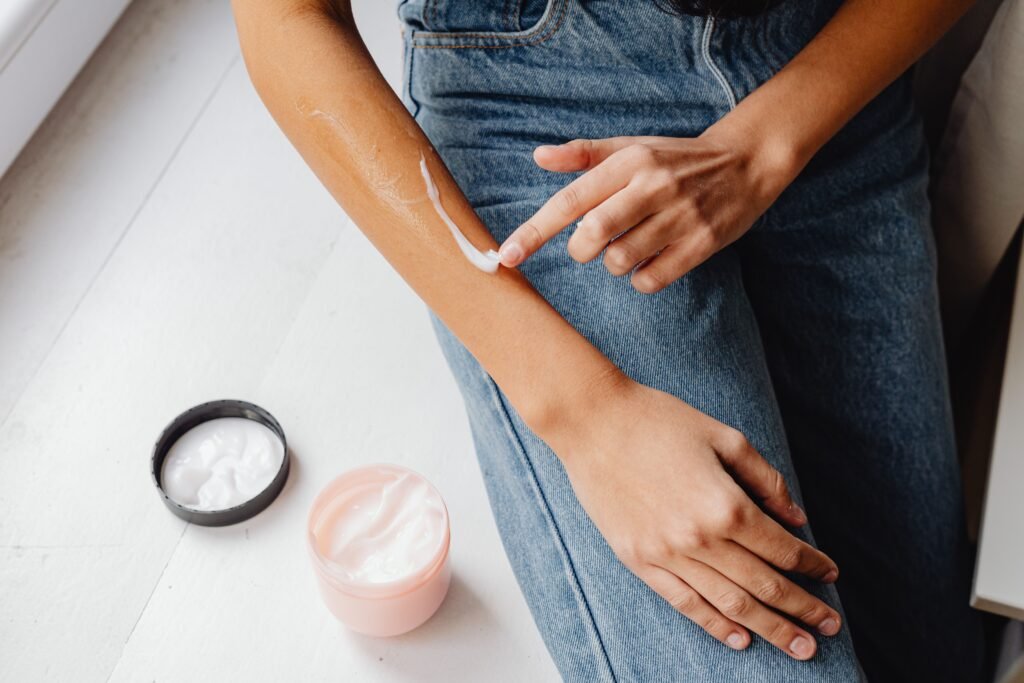
How does TCM understand eczema?
There is no single TCM diagnosis corresponding exactly to the Western medical diagnosis of eczema.
Instead, the practitioner looks at the pattern underlying the particular person’s symptoms.
Several traditional patterns may be involved, including Wind, Heat, Dampness, and Blood deficiency, often in combination.
The term “Wind” is particularly important in traditional dermatology. It is associated with symptoms that move around, appear suddenly, or cause intense itching. Someone whose eczema seems to flare in different places, or who experiences particularly restless itching, may therefore show signs of what TCM describes as Wind.
Heat may be suggested by red, inflamed or hot-feeling skin, particularly when the itching is severe. Some people find that warmth makes their eczema considerably worse.
Dampness may be involved when there is swelling, weeping or oozing from the skin. From a TCM perspective, Dampness is also closely associated with digestion and the function traditionally attributed to the Spleen.
In longer-standing eczema, the picture can change. The skin may become dry, thickened and cracked, and the intense inflammatory appearance of an earlier stage may give way to persistent dryness and itching. A practitioner may then consider Blood deficiency or other forms of deficiency as part of the underlying pattern.
These patterns are not necessarily separate stages. A person may have Heat and Dampness together, for example, or an underlying deficiency with an acute flare involving Wind and Heat.
This is why TCM treatment is generally individualised rather than based simply on the word “eczema.”
Acute and chronic eczema
One of the useful features of the Chinese medical approach is that it distinguishes between the current manifestation and the underlying tendency.
During an acute flare, the main priority may be to reduce itching, redness, inflammation and irritation. Depending on the presentation, treatment may focus on clearing Heat, resolving Dampness and reducing Wind.
Once the flare has settled, the treatment may change.
Someone who has had eczema for many years may have a very different underlying pattern from someone who has suddenly developed an intensely red and itchy rash. The chronic patient may have dry skin, disturbed sleep, fatigue or other signs of deficiency, for example.
Consequently, the treatment that was appropriate during a severe flare may not be the treatment that is most appropriate several weeks later.
Acupuncture for eczema
Acupuncture is sometimes used as part of a TCM approach to eczema, particularly when itching is a prominent symptom.
Treatment is not necessarily directed at the affected patch of skin itself. Acupuncture points may be selected according to the individual’s overall Chinese medicine diagnosis.
For example, treatment may be aimed at:
- reducing itching
- clearing Heat
- regulating the circulation of Qi and Blood
- addressing Dampness
- supporting digestion
- improving sleep
- helping the body recover after a prolonged inflammatory condition
The precise treatment therefore varies considerably from person to person.
There is some clinical evidence for acupuncture in atopic dermatitis. A 2024 systematic review and meta-analysis of eight randomised controlled trials involving 463 people found improvements in SCORAD, itching and quality of life, although the authors emphasised that the number and quality of studies were still limited. No serious adverse events were reported in the included trials.
Earlier research reached broadly similar but cautious conclusions: acupuncture appeared potentially useful for itching and eczema severity, but the evidence was not strong enough to establish exactly how effective it is or which patients are most likely to benefit.
Acupuncture should therefore be regarded as a possible complementary treatment rather than a guaranteed cure for eczema.
Chinese herbal medicine for eczema
Chinese herbal medicine has traditionally played an important role in the treatment of skin diseases.
Unlike a standardised Western drug prescribed simply for “eczema”, a Chinese herbal prescription is normally constructed around the individual’s pattern.
Two people with eczema might therefore receive completely different prescriptions.
A prescription for someone with a red, hot and weeping eruption might be quite different from one for someone with dry, cracked and thickened skin.
Herbal treatment may be used with aims such as:
- clearing Heat
- draining Dampness
- expelling Wind
- nourishing Blood
- supporting the Spleen
- restoring balance after a prolonged illness
There is some encouraging evidence for Chinese herbal medicine, but it is important not to exaggerate what the research tells us. An updated systematic review published in 2023 found that Chinese herbal medicine was associated with a higher overall recovery rate and lower recurrence in the studies analysed, but it did not find a significant difference in Eczema Area and Severity Index or quality of life, and the authors called for further research.
Topical Chinese herbal preparations have also been studied, with a 2023 systematic review finding potential benefits, particularly in mild-to-moderate atopic dermatitis.
However, herbal medicines are not automatically safe simply because they are traditional or natural. Quality, identification of herbs, preparation and possible interactions with medicines all matter. Some commercially available topical products labelled as Chinese herbal medicines have also been found to contain undisclosed pharmaceutical steroids.
For this reason, herbal treatment should be prescribed by a properly qualified practitioner using appropriately sourced products.
Treating the person rather than just the skin
One of the most interesting aspects of TCM treatment is that the practitioner does not necessarily regard the eczema as an isolated problem.
For example, a person with eczema might also complain of:
- bloating or digestive discomfort
- loose stools or constipation
- poor sleep
- tiredness
- feeling unusually hot or cold
- headaches
- menstrual difficulties
- anxiety or irritability
These symptoms may help the practitioner understand the person’s overall Chinese medicine pattern.
This does not mean that TCM assumes that eczema is “caused by the liver”, poor digestion, stress or any other single factor. Rather, the symptoms are considered together when arriving at a traditional diagnosis.
The tongue and pulse are also important parts of a traditional Chinese medicine consultation. They can provide additional information about the pattern that is being treated.
Can acupuncture cure eczema?
It is better to be cautious about the word “cure”.
Eczema is often a chronic, relapsing condition, and even conventional medical treatment generally aims at controlling inflammation and maintaining the skin barrier rather than guaranteeing that the condition will never return.
TCM treatment similarly aims to reduce symptoms and improve the person’s overall pattern.
Some people may experience substantial improvement. Others may find that treatment mainly reduces itching or helps them manage recurrent flares.
The response will depend on the individual, the type and severity of eczema, how long it has been present and many other factors.
TCM should therefore be viewed as one possible approach to managing eczema rather than as a replacement for appropriate medical care.
TCM and conventional treatment
There is no reason for someone receiving acupuncture for eczema to stop medical treatment that has been prescribed for them.
In fact, an integrated approach can sometimes make the most sense.
Moisturisers and other measures to protect the skin barrier remain important. Prescription treatments such as topical corticosteroids may also be appropriate during significant flares.
Acupuncture or Chinese medicine can be considered alongside conventional treatment where appropriate.
The available research on integrated Chinese and Western medicine is encouraging in some respects, but the quality of the evidence remains variable. A large systematic review found apparent benefits from combining Chinese and Western approaches, while also noting that most of the studies included were at high risk of bias.
What happens during a TCM consultation for eczema?
A consultation will normally begin with a detailed discussion of the eczema itself.
You may be asked:
- When did it begin?
- Where on the body does it occur?
- Is the skin dry, red, swollen, thickened or weeping?
- How severe is the itching?
- Is it worse at night?
- Does heat make it worse?
- Does it move from one area to another?
- What seems to trigger a flare?
- What treatments have you already tried?
The practitioner will then consider these findings alongside your general health, digestion, sleep, energy, tongue and pulse.
The aim is to arrive at an individual Chinese medicine diagnosis rather than simply treating “eczema” as a single condition.
When should eczema be medically assessed?
Eczema can sometimes become infected, particularly when the skin is broken from scratching.
Medical assessment is important if the skin becomes increasingly painful, hot, swollen or rapidly worse, or if there is significant weeping, crusting, pus or fever.
Particularly severe or rapidly developing rashes should also be assessed medically, since not every itchy or inflamed rash is eczema.
TCM treatment can be used alongside appropriate medical diagnosis and treatment, but should not delay assessment of potentially serious skin disease.
A different way of looking at eczema
Perhaps the most useful contribution that TCM can make to the treatment of eczema is its insistence on looking at the individual case.
The skin is where the problem is visible, but the traditional diagnosis considers the person as a whole.
One person’s eczema may be predominantly red and inflamed; another’s may be dry and cracked; another’s may involve considerable oozing and swelling. Their general symptoms may be quite different as well.
For this reason, there is no single acupuncture point or Chinese herbal formula that is appropriate for everyone with eczema.
Instead, treatment is adapted according to the particular pattern found in the individual patient.
For people looking for an alternative or complementary approach to managing chronic eczema, acupuncture and Chinese medicine may therefore be worth considering alongside appropriate conventional skin care and medical treatment.
Leave a Reply